Leadership Fireproof Systems
These essays explore leadership, nervous system capacity, and the organizational structures that shape how responsibility is carried.
In high-responsibility environments, burnout is often framed as a personal resilience problem.
More often it reflects sustained responsibility being carried without the systems required to support biological regulation, recovery, and sustainable leadership.
The writings in this section examine leadership through the lens of nervous system science and organizational design.
They explore questions such as:
• What happens biologically when leaders carry pressure without sufficient margin?
• How do leadership cultures unintentionally normalize chronic overextension?
• What structural conditions allow leaders to sustain responsibility without internal collapse?
The goal of this work is simple:
to design leadership systems where sustained performance does not require human erosion.
These writings form part of my broader work in Leadership Capacity Architecture — helping leaders strengthen their nervous system capacity and helping organizations design systems that protect and regenerate the people carrying responsibility.
Leadership is meant to regenerate life, not extract it.

Where Leadership Patterns Actually Begin
Some leadership patterns do not begin at work.
They begin much earlier, in what we learn about responsibility.
What it means to hold things together.
What it takes to carry pressure.
What keeps systems stable.
Long before someone steps into formal leadership, these definitions are already forming. They become internal blueprints that quietly shape how responsibility is carried over time.
For me, some of that blueprint was shaped in my relationship with my father.
He understood how to build and hold structure.
He could take raw materials and turn them into something functional and beautiful, something that lasted.
But he did not know how to create emotional safety.
And emotional safety is not a soft concept in leadership.
It is part of the internal structure that allows capacity to hold under pressure.

Leadership Capacity Architecture: A Systems Framework for Sustainable Leadership (Full Version)
Leadership capacity is not a fixed trait.
It is an emergent property of three interacting systems:
Biology (nervous system capacity)
Meaning (internal narrative and belief structures)
Environment (organizational design and load distribution)
When these systems are aligned, leaders operate with clarity, responsiveness, and sustainable performance.
When they are misaligned, strain accumulates and is often misinterpreted as personal limitation.
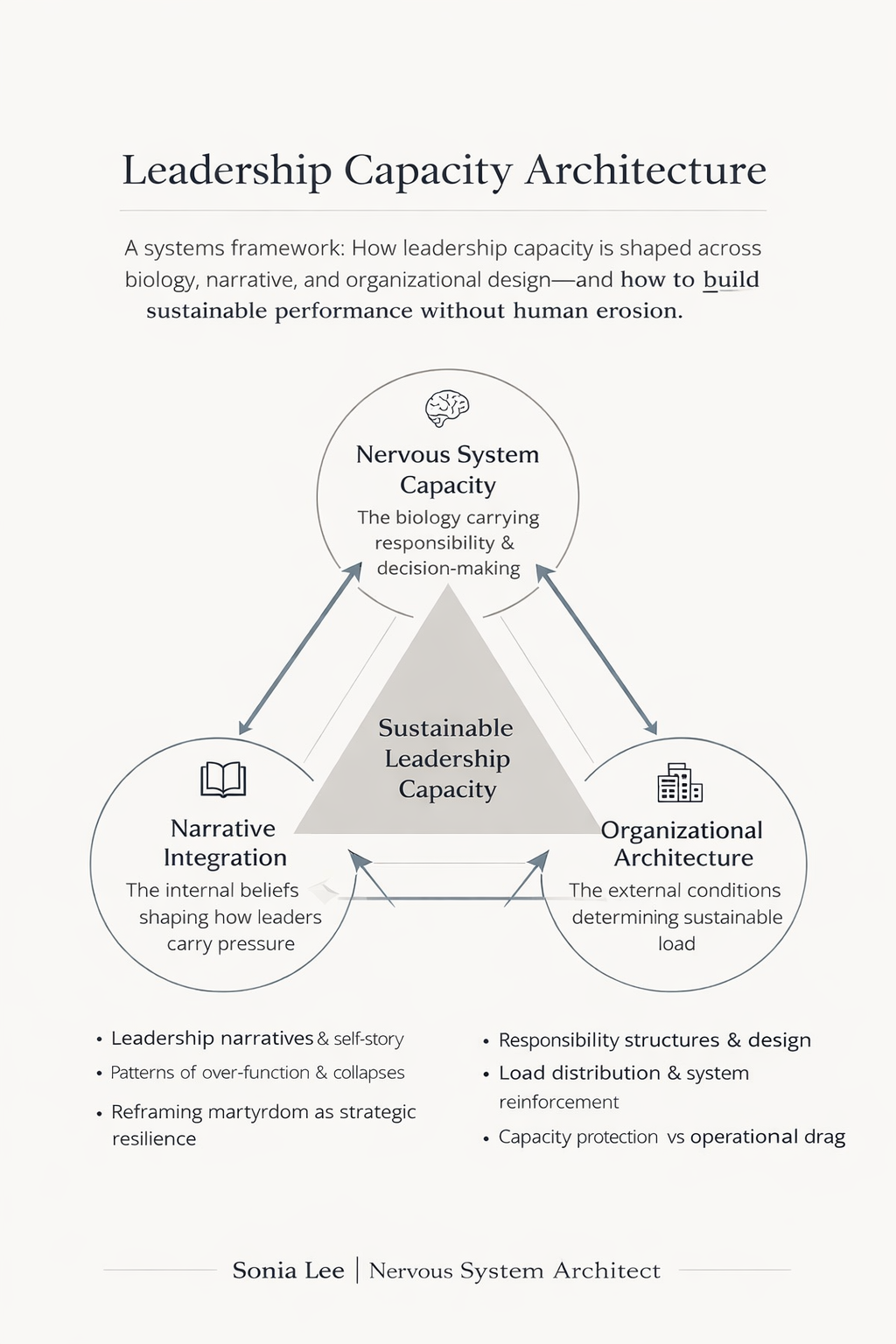
Leadership Capacity Architecture Diagram
Leadership Capacity Architecture Diagram
The Capacity Crisis in Leadership
Leadership today is operating under levels of sustained pressure that human nervous systems were never designed to carry indefinitely.
Across industries, leaders are responsible for increasingly complex decisions, rapid change, emotional intensity, and organizational uncertainty.
Yet most leadership development continues to focus primarily on strategy, productivity, and communication.
What is often overlooked is the biological system carrying all of that responsibility:
The nervous system.
Designing Fireproof Systems
Fireproof systems are systems that can absorb pressure without consuming the humans inside them.
They ensure that:
responsibility does not require self-erasure
urgency does not bypass recovery
meaning and belonging does not depend on depletion
leadership does not require human sacrifice
This is not resilience training.
It is infrastructure.

What Is Narrative & Nervous System Integration?
Over the course of our lives there are moments that shape us.
Experiences that mark us, form us, and sometimes fracture something deep within our sense of self.
Many of us move quickly past these moments.
We stay busy.
We stay productive.
We stay responsible.
But unresolved experiences do not simply disappear.
They live quietly in the body, in the nervous system, and in the stories we carry about ourselves, others, and the world.